
Who Owns Alameda’s Digital Future? The Case for Solar-Powered Micro Data Centers at Alameda Point
I am a new resident and voter in the city of Alameda. This was created with the help of AI. We are seeking community stakeholders to validate numbers and map out concrete action plans we can take that could set an example for the rest of the country to adopt. I am the president of a 501(c)(3). We are not seeking venture capital. Rather, we are building bridges, not moats as we seek community stakeholders, and citizens who would like to engage in a cooperative effort for sustainable change. Humanity and the future of the planet are being threatened by monopolies who would be happy to see offshore drilling in California for power plants to feed the ravenous appetite for electricity possessed by AI monopolies hungering for electricity.
I want to start with a simple but powerful question: Who owns your community’s digital future? Right now, the honest answer for most cities—including Alameda—is that someone else does. Tech giants in Seattle, Dublin, and Virginia control the servers, set the prices, extract the profits, and leave your community with the electricity bill .
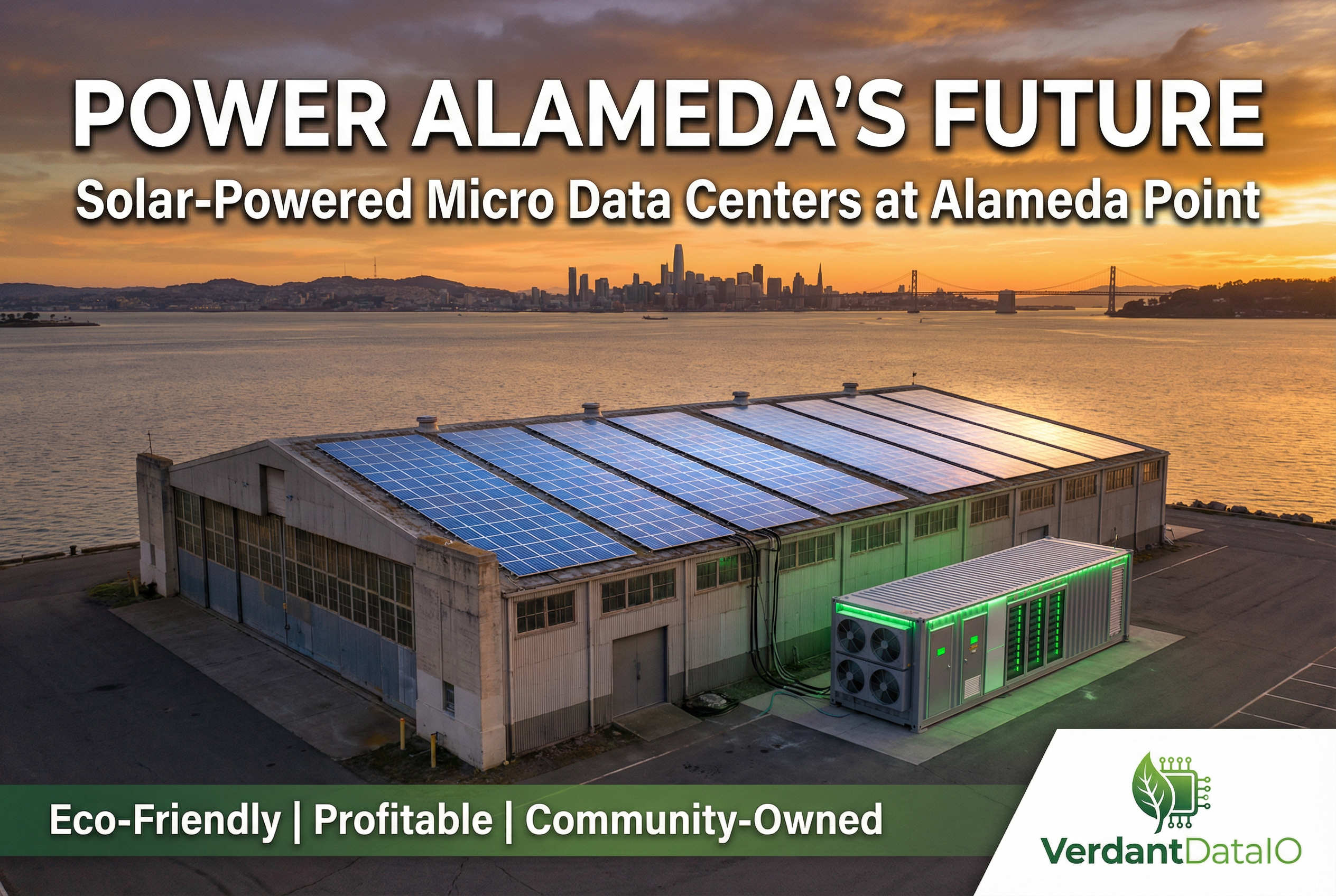
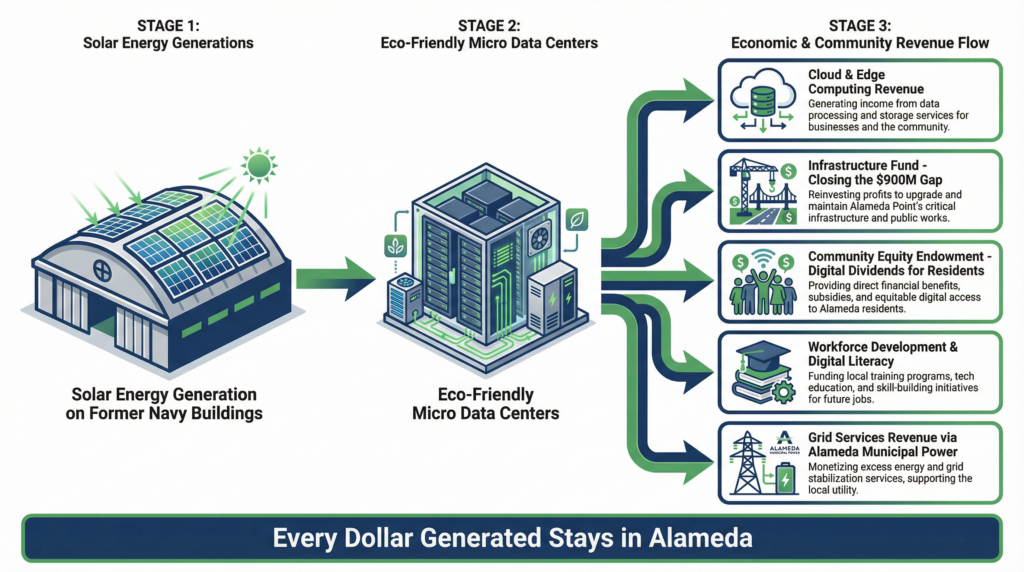
However, the City of Alameda has a once-in-a-generation opportunity to change this dynamic. By cooperating with efforts to install solar panels on the roofs of former Navy buildings at Alameda Point to power eco-friendly, decentralized micro data centers, the city can solve its infrastructure funding crisis, become a leader in sustainable technology, and ensure that the profits of the digital economy stay local.
The Convergence Moment: Why Now?
We are currently experiencing what the Future Today Strategy Group calls “Compute Shock” . Artificial intelligence and cloud services are consuming so much electricity and water that computation is no longer free to roam the internet. Instead, it is becoming anchored to specific places with surplus power and cooling.
AI workloads are compounding faster than efficiency gains, with frontier workloads doubling roughly every 6 to 10 months . A single hyperscale AI data center can require 100 to 500 megawatts of continuous power—equivalent to a small city—and consume 3 to 5 million gallons of water daily for cooling . The U.S. electrical grid, designed for 1% annual growth, simply cannot handle this demand.
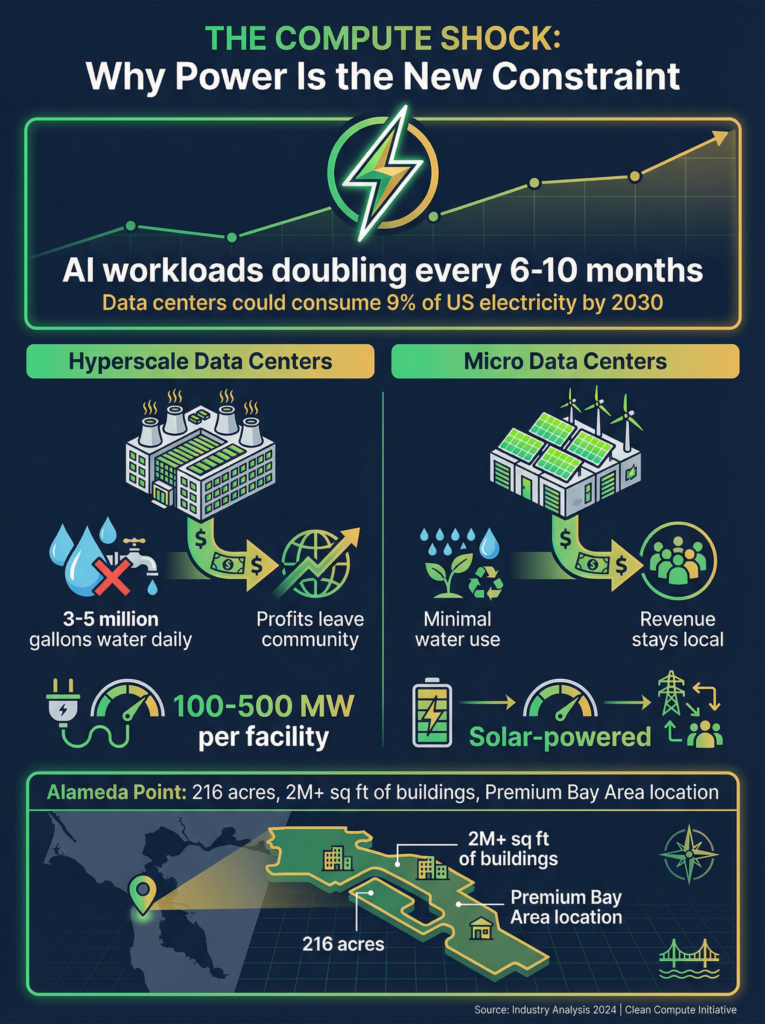
Because of these physical constraints, the cloud is coming down to Earth. Computing is fracturing into distinct forms, and latency-sensitive applications require “edge nodes”—computing power located close to major metropolitan areas . This makes the San Francisco Bay Area premium real estate for edge computing, and Alameda Point is perfectly positioned to capitalize on this shift.
Alameda Point: The Perfect Candidate
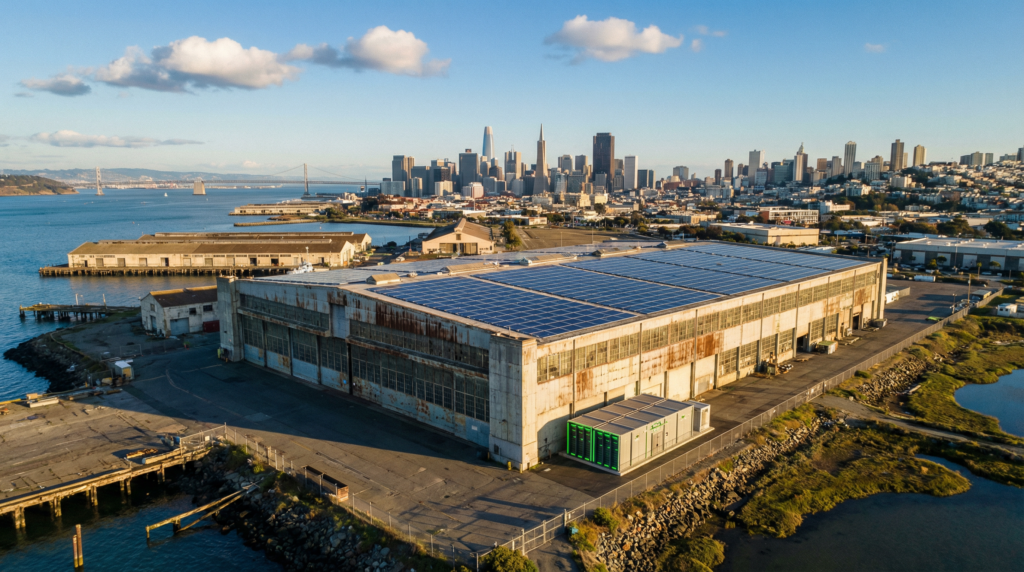
Alameda Point, the former Naval Air Station, represents an incredible underutilized asset. The Adaptive Reuse Sub-Area provides 216 acres of land and over 2 million square feet of existing buildings . These massive former military hangars and structures feature enormous flat rooftops that are ideal for commercial-scale solar panel installations.
Simultaneously, the City of Alameda is facing a significant financial challenge. Since 2020, the estimated costs to complete the remaining Alameda Point infrastructure—including streets, utilities, parks, levees, and stormwater basins—have soared from $700 million to $900 million . Land values have softened, and aging historic buildings are becoming increasingly expensive to maintain . The city’s current strategy of relying primarily on land sales is unlikely to fully fund this $900 million gap .
Alameda needs a new revenue model. By utilizing the existing building shells, the city can reduce construction costs and timelines dramatically compared to greenfield development. Furthermore, Alameda has a unique advantage: Alameda Municipal Power (AMP), a city-owned utility that already has programs for eligible renewable generation and can facilitate the interconnection of solar-powered microgrids .
Avoiding the “Data Colony” Trap
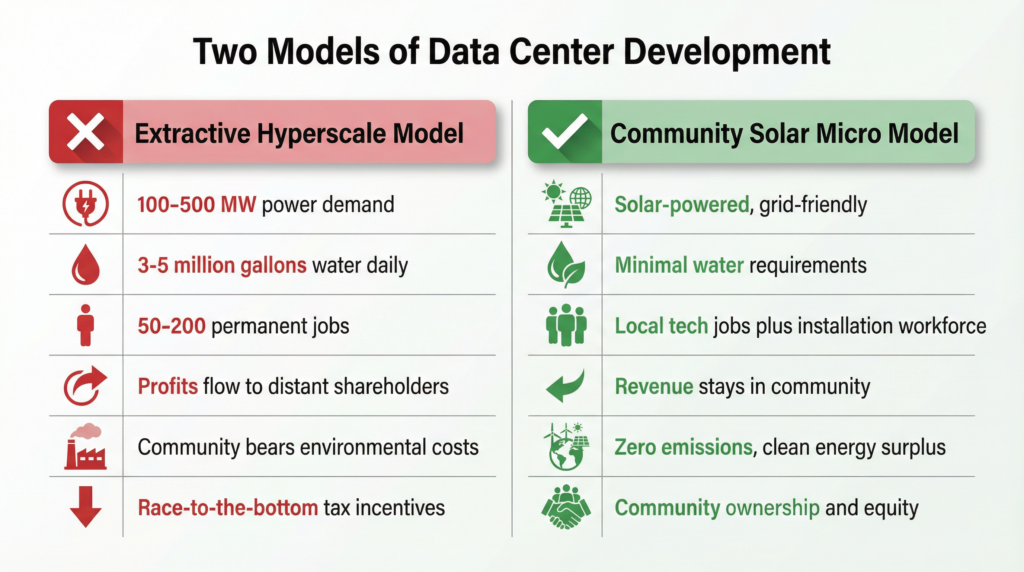
As the data center boom accelerates, many communities are falling into the “data colony” trap. In this extractive model, external capital exploits local resources (power, water, land) through negotiated agreements, while the bulk of the economic value accrues to distant shareholders . These hyperscale facilities create minimal permanent jobs (often just 50 to 200 operational employees) while leaving the local community to bear the costs of grid upgrades, water treatment expansion, and environmental externalities .
| Feature | Extractive Hyperscale Model | Community Solar Micro Model |
| Power Demand | 100-500 MW continuous drain on local grid | Solar-powered with battery storage, grid-friendly |
| Water Usage | 3-5 million gallons daily for evaporative cooling | Minimal water requirements |
| Job Creation | 50-200 permanent jobs, highly specialized | Local tech jobs plus ongoing solar installation workforce |
| Economic Value | Profits flow to distant corporate shareholders | Revenue stays in the community (Digital Dividends) |
| Environmental Impact | Community bears externalities (heat, noise, emissions) | Zero emissions, potential clean energy surplus |
| Governance | Corporate control, opaque operations | Community ownership and cooperative governance |
Organizations like VerdantDataIO are pioneering a different path: transforming data centers and AI with local renewable energy . Their model focuses on community micro-data hubs powered by solar, cooperative governance models, and energy-aware cloud services optimized for local use . This decentralized approach ensures that every dollar saved, every watt generated, and every byte stored locally stays local—fueling community wealth instead of corporate monopolies .
Policy Recommendations for the City of Alameda
To seize this opportunity, the City Council must move beyond the standard calculus of real estate transactions and treat Alameda Point as an ecosystem-shaping moment . The city should adopt the following policy framework:
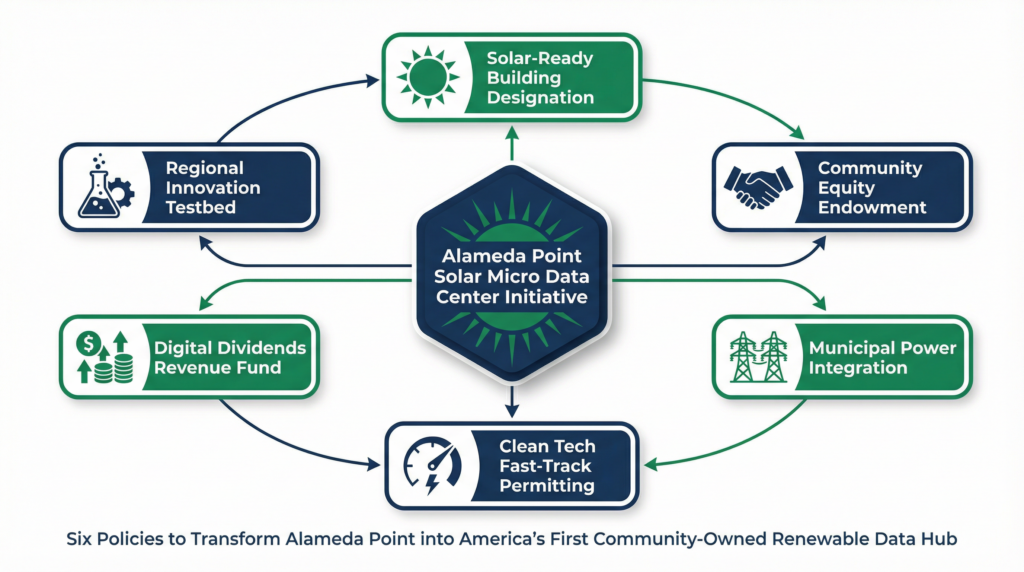
1. Solar-Ready Building Designation Ordinance
The city should immediately survey and designate suitable former Navy buildings (such as the Building 11/400/12 Complex) for solar installation and micro data center adaptive reuse. This ordinance should streamline permitting for rooftop solar on these specific buildings and create an overlay zone that encourages the pairing of clean energy generation with edge computing.
2. Community Equity Endowment (CEE) Framework
Moving from a basic “community benefit” model to a “shared prosperity” model, the city should require data center operators to transfer a portion of their equity or revenue into a Community Equity Endowment . This fund, overseen by community members, would distribute financial returns locally, providing direct benefits, subsidies, or equitable digital access to Alameda residents.
3. Municipal Power Integration Program
Working with Alameda Municipal Power (AMP), the city should create a specialized rate structure and interconnection pathway for solar-powered micro data centers. This program should allow these facilities to monetize excess energy and provide grid stabilization services, turning the data centers into assets for the local grid rather than liabilities.
4. Clean Tech Fast-Track Permitting
To attract the right kind of investment, Alameda should offer expedited permitting and reduced fees for adaptive reuse projects that meet strict sustainability criteria (100% renewable power, zero water cooling). This trades infrastructure access for commitments to advance local innovation and environmental goals .
5. Digital Dividends Revenue Fund
A dedicated portion of the lease revenue and taxes generated by these micro data centers must be legally ring-fenced into an Infrastructure Fund specifically designed to close the $900 million Alameda Point infrastructure gap . Additional funds should be allocated to local workforce development and digital literacy programs.
6. Regional Innovation Testbed Partnership
The city should require data center operators to establish R&D testbeds in partnership with local universities (like UC Berkeley) and startups . This transforms isolated data centers into collaborative innovation hubs, making Alameda Point highly competitive for federal grants like the EDA Tech Hubs Program.
A Call to Action
The era of borderless, consequence-free computing is over. As power becomes physical again, geography is destiny. Alameda possesses the land, the buildings, the municipal utility, and the strategic location to build a regenerative digital economy.
The City Council should immediately commission a feasibility study for solar-powered micro data centers at Alameda Point, engage with organizations like VerdantDataIO, and launch a pilot project on a single designated building. By acting now, Alameda can ensure that its digital future is owned by, powered by, and profitable for the people of Alameda.
References
VerdantDataIO. “Eco Friendly Profitable Decentralized Micro Data Centers.” Alameda Point.
City of Alameda. “Alameda Point Planning Guide.”
Alameda Municipal Power. “Solar at AMP.”
VerdantDataIO. “Transforming data centers and AI with local renewable energy.”