| Support | Alameda is vulnerable to earthquakes and sea-level rise. Solar-powered micro data centers with battery storage could serve as emergency power hubs during disasters, keeping critical communications and services running when the main grid goes down. The study should evaluate this resilience benefit. | Emergency Preparedness Volunteer | Resilience & Disaster Recovery |
| Support | Alameda Point already has a vibrant arts community with studios and maker spaces. Affordable, locally powered computing could support digital artists, VR creators, and media producers. The feasibility study should explore how micro data centers can serve the creative economy, not just big tech. | Arts Community Member | Creative Economy Synergy |
| Strongly Support | Alameda Point has been underutilized for too long. If these micro data centers can bring in revenue and high-paying tech jobs without causing traffic nightmares or straining parking, I am all for it. Let us get the study done so we can see the real numbers and move forward. | Local Business Owner | Economic Revitalization |
| Cautiously Support | Alameda Point is home to the endangered California least tern nesting site. Solar panel installations and increased human activity must not disturb sensitive wildlife habitats. The feasibility study needs to include a biological assessment and ensure compliance with the Endangered Species Act. | Birding Club Member | Wildlife & Habitat |
| Support | Any feasibility study must address digital accessibility. Will the community programs funded by these data centers include assistive technology, accessible broadband options, and employment opportunities for people with disabilities? Inclusion must be baked into the design from the start, not added as an afterthought. | Disability Rights Advocate | Accessibility & Digital Inclusion |
| Neutral | As a council member in a neighboring city, I am watching Alameda's approach closely. If this model works, it could be replicated across the East Bay. The feasibility study should consider regional partnerships and whether a network of micro data centers across multiple cities would be even more effective. | Neighboring City Official | Regional Impact |
| Support | As a parent, I want Alameda to be a place where my kids can find good jobs after college without having to commute to San Francisco. If micro data centers create local tech employment and fund STEM programs in our schools, that is a future I want to invest in. A feasibility study is a smart first step. | Parent & PTA Member | Safe Community & Youth Opportunity |
| Strongly Support | As a solar installer based in Alameda, I can tell you that the rooftops on those former Navy buildings are ideal for large-scale photovoltaic arrays. The feasibility study should quantify the megawatt capacity of each building and the number of installation jobs it would create. This is a huge opportunity for the local solar workforce. | Renewable Energy Installer | Solar Industry & Local Jobs |
| Strongly Support | As someone working in AI, I know how critical edge computing is becoming. Having low-latency, eco-friendly compute nodes right here in the Bay Area is a huge competitive advantage. The study should explore how we can partner with local startups and UC Berkeley to make Alameda Point an innovation testbed. | Local Tech Worker | Edge Computing & Innovation |
| Neutral | Before I can support or oppose this, I need the feasibility study to address zoning compatibility. How does a micro data center overlay zone interact with the existing Adaptive Reuse Area plan? What are the parking, setback, and noise requirements? We need to ensure this fits within our General Plan framework. | Planning Commissioner | Zoning & Land Use |
| Strongly Support | Cloud computing costs are killing small startups. If Alameda Point could offer affordable, locally hosted edge computing powered by solar, it would be a game-changer for the Bay Area startup ecosystem. The feasibility study should explore pricing models that give local businesses priority access. | Small Tech Startup Founder | Affordable Compute Access |
| Cautiously Support | Community-owned data centers sound great in theory, but who decides what data gets stored and processed? The feasibility study must address data ethics, ensure no surveillance applications are hosted, and establish a community oversight board with real authority over acceptable use policies. | Privacy Advocate | Surveillance & Data Ethics |
| Oppose | Data centers are notoriously loud and consume massive amounts of power. Even if they claim to be solar-powered, what happens at night or on cloudy days? Will Alameda Municipal Power customers end up footing the bill for grid upgrades? The study needs to be completely independent and look hard at the downsides, not just the marketing pitch. | Skeptical Resident | Noise & Grid Strain |
| Neutral | Data centers contain lithium-ion batteries and high-density electrical equipment that present specific fire risks. The feasibility study must include a fire safety assessment, evaluate suppression system requirements, and confirm that the Alameda Fire Department has the training and equipment to respond to incidents at these facilities. | Fire Department Representative | Safety & Fire Risk |
| Cautiously Support | Decentralized data centers raise important questions about data security and privacy. The feasibility study should address what types of data will be processed, what security certifications the facilities will maintain, and how the city will ensure compliance with California privacy laws. | Cybersecurity Professional | Data Security & Privacy |
| Cautiously Support | Every time a city announces a tech initiative, rents go up and long-time residents get pushed out. I will only support this if the feasibility study includes anti-displacement protections and ensures that the Community Equity Endowment directly benefits current Alameda residents, especially renters and low-income families. | Anti-Gentrification Activist | Displacement & Affordability |
| Support | From a municipal finance perspective, predictable revenue from data center leases could improve the city's bond rating and borrowing capacity for Alameda Point infrastructure. The feasibility study should model multiple revenue scenarios and show how this income stream could be leveraged for infrastructure financing. | Municipal Finance Analyst | Revenue Modeling & Bond Capacity |
| Support | From a utility perspective, solar-powered micro data centers could be a significant asset for Alameda Municipal Power. They can provide demand response services, battery backup during outages, and a new revenue stream through specialized rate structures. The feasibility study should model the impact on AMP's long-term financial health. | AMP Board Member | Utility Revenue & Grid Modernization |
| Oppose | How much will this feasibility study itself cost? Who is paying for it? I have seen too many expensive consultant reports that lead nowhere. Before spending a dime, the city should require the private companies proposing this to fund the study themselves. If they believe in the economics, they should put their own money up. | Concerned Taxpayer | Cost & Accountability |
| Cautiously Support | I am not against renewable energy, but the former Navy hangars are historic assets that define Alameda Point's character. The feasibility study must include a rigorous architectural assessment to ensure that installing heavy solar arrays and data center equipment will not damage the structural integrity or visual character of these buildings. | Historic Preservationist | Building Integrity & Heritage |
| Strongly Support | I am studying computer science at the College of Alameda. If these micro data centers create internship and apprenticeship opportunities for local students, it could change the trajectory of my career. The feasibility study should explore a direct workforce pipeline with the College of Alameda and local community colleges. | College of Alameda Student | Workforce Training Pipeline |
| Cautiously Support | I have concerns about how data center operations might affect property values in the surrounding residential areas. However, if the study shows that solar-powered micro data centers are quiet, clean, and visually unobtrusive, they could actually enhance the area's appeal as a tech-forward community. | Real Estate Developer | Property Values & Market Impact |
| Cautiously Support | I have lived in Alameda for 35 years and watched Alameda Point sit mostly empty since the Navy left. I am tired of waiting for something to happen, but I also do not want the city to rush into a bad deal. A feasibility study is the right approach. Take the time to get it right, but please actually do something this time. | Long-time Alameda Resident | Pace of Change |
| Oppose | I moved to Alameda for the quiet, family-friendly environment. I am worried that data centers, even small ones, will bring industrial noise, increased truck traffic for equipment delivery, and electromagnetic interference. The study must include a comprehensive quality-of-life impact assessment for nearby residents. | Waterfront Resident | Quality of Life Concerns |
| Strongly Support | I run a design studio at Alameda Point and our internet connectivity is terrible. If micro data centers bring better broadband infrastructure to the area as a byproduct, that alone would be worth it. The study should look at how this improves connectivity for existing tenants and businesses at Alameda Point. | Commercial Tenant at AP | Tenant Benefits & Connectivity |
| Strongly Support | I strongly support commissioning this feasibility study. If we can utilize the massive rooftops at Alameda Point for solar power, we can host data centers without the massive carbon footprint and water waste typical of hyperscale facilities. The study should strictly evaluate the zero-water-cooling claims and confirm that these micro data centers truly operate at net-zero emissions. | Environmental Advocate | Clean Energy & Zero Emissions |
| Support | I support the study if it includes an analysis of local hiring requirements and prevailing wage standards for the solar installation and data center construction work. We need to make sure these are good union jobs that benefit Alameda workers, not just imported contract labor. | Local Union Representative | Workforce & Labor Standards |
| Support | I take the Alameda ferry every day from Alameda Point. More economic activity at the Point means better justification for expanded ferry service and transit improvements. If the feasibility study shows that micro data centers will bring workers and revenue to the area, it strengthens the case for transit investment too. | Ferry Commuter | Transit Integration |
| Support | I teach at a middle school in Alameda, and many of my students lack reliable internet access and digital skills. If part of the revenue from these data centers goes toward digital literacy programs and STEM education, this could be transformative for our kids. The study should include an education impact assessment. | Alameda Teacher | Education & Digital Literacy |
| Cautiously Support | I want to see a health impact assessment included in the feasibility study. Even if these are smaller than hyperscale data centers, we need to understand the electromagnetic field exposure, air quality impacts from any backup generators, and heat island effects on surrounding neighborhoods. | Public Health Nurse | Health Impact Assessment |
| Support | I want to see exactly how this will integrate with Alameda Municipal Power. If the battery storage from these micro data centers can actually provide grid stabilization and push excess solar power back to our local grid during peak hours, it is a genuine win for all ratepayers. The study needs to model the electrical engineering side thoroughly. | Utility Engineer | AMP Grid Integration |
| Neutral | I will reserve judgment until I see the feasibility study itself. What matters most is that the process is transparent, that the study is conducted by an independent firm with no financial stake in the outcome, and that the results are made fully available to the public before any decisions are made. | Local Journalist | Transparency & Public Process |
| Support | If the Digital Dividends fund can contribute to affordable housing development at Alameda Point, this project could help address two crises at once. The feasibility study should model how data center revenue could be paired with housing trust fund contributions to accelerate affordable unit construction. | Alameda Housing Authority Rep | Affordable Housing Synergy |
| Support | If this project can generate revenue for the city without raising my property taxes, I am interested. Alameda's cost of living keeps going up, and we need creative solutions. A feasibility study is a reasonable first step before committing any public money. | Senior Citizen | Property Taxes & Cost of Living |
| Strongly Support | It is sad seeing those massive hangars sitting empty and deteriorating year after year. They were built to support cutting-edge technology decades ago. Repurposing them for solar and data centers honors that legacy while bringing them into the 21st century. Please approve the study and get things moving. | Former Navy Base Worker | Adaptive Reuse & Legacy |
| Support | Our nonprofit serves low-income families in Alameda, and we are always struggling for funding. If the Digital Dividends model can create a sustainable revenue stream for community services, housing assistance, and after-school programs, this could be a model for the entire country. Please fund the feasibility study. | Nonprofit Director | Community Services Funding |
| Support | The Chamber supports exploring innovative economic development strategies for Alameda Point. A feasibility study for solar-powered micro data centers aligns with our goals of attracting clean technology businesses and creating a competitive business environment. We encourage the city to move forward with the study. | Alameda Chamber of Commerce | Business Climate & Competitiveness |
| Support | The city's fiscal neutrality policy for Alameda Point is clearly failing. Land sales cannot close a $900 million gap. A feasibility study for micro data centers is exactly the kind of creative thinking we need. But I want to see independent financial projections, not just optimistic estimates from the companies that stand to profit. | City Council Watcher | Fiscal Neutrality & Accountability |
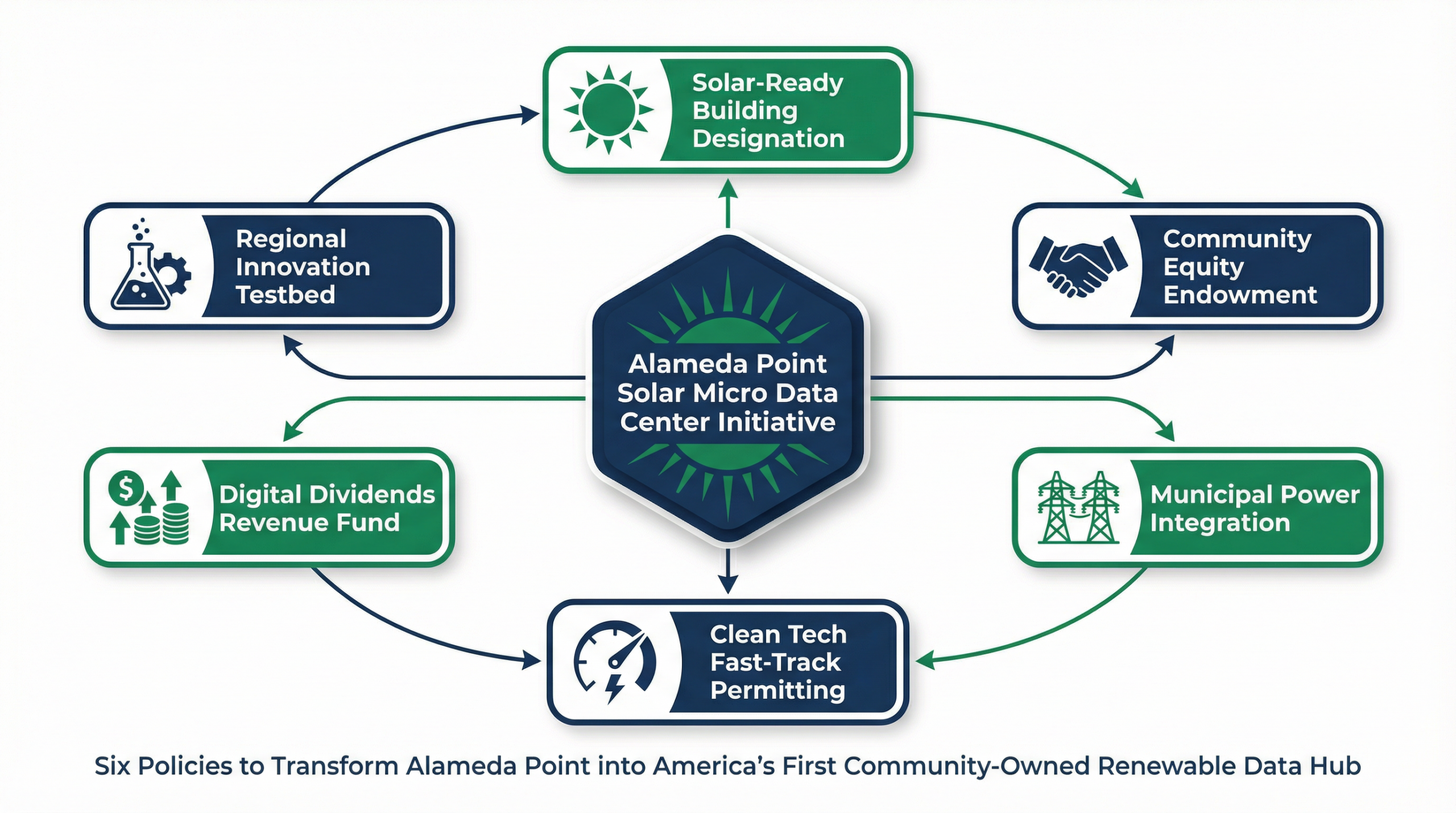
| Strongly Support | The concept of a Community Equity Endowment is what excites me most about this proposal. If we are going to use public land and buildings, the profits must not just leave our community. The feasibility study must prioritize how the revenue sharing model will work to fund digital literacy programs, workforce training, and direct community benefits. | Community Equity Advocate | Digital Dividends & Equity |
| Strongly Support | The cooperative governance model proposed by VerdantDataIO is exactly what Alameda needs. Just as rural electric cooperatives transformed America in the 1930s, community-owned digital infrastructure can transform our local economy. The feasibility study should specifically evaluate cooperative ownership structures and democratic governance frameworks. | Cooperative Housing Advocate | Cooperative Governance Model |
| Strongly Support | The data center industry is on track to consume 9 percent of U.S. electricity by 2030. Solar-powered micro data centers represent one of the few viable paths to decarbonize this sector. Alameda should be proud to lead this effort. The feasibility study should quantify the carbon offset compared to conventional data center alternatives. | Climate Scientist | Carbon Reduction & Innovation |
| Support | The engineering concept is sound. Solar panels on large flat roofs feeding battery storage and modular data center pods is proven technology. The real question the feasibility study needs to answer is whether the economics work at the scale Alameda Point offers and whether the existing building structures can handle the load. | Retired Engineer | Technical Feasibility |
| Cautiously Support | The feasibility study must include a comprehensive risk assessment covering natural disasters, equipment failure, cybersecurity breaches, and liability exposure. Alameda Point's location in a seismic zone and flood-prone area raises specific insurance and risk management questions that need professional evaluation. | Insurance Professional | Risk Assessment |
| Neutral | The feasibility study must include a traffic impact analysis. How many vehicle trips will construction, maintenance, and operations generate? Alameda Point already has limited road access. We need to ensure this does not worsen congestion at the Webster and Posey tubes or on Main Street. | Transportation Planner | Traffic & Access |
| Strongly Support | The micro data center model is attracting serious venture capital nationally. If Alameda moves quickly, it can position itself as a first-mover in community-owned edge computing. The feasibility study should include a market analysis showing investor appetite and potential for scaling beyond a single pilot building. | Venture Capitalist | Investment & Scalability |
| Strongly Support | The timing for this feasibility study could not be better. Edge computing demand in the Bay Area is exploding, and available power capacity is the number one constraint. Alameda Point's combination of existing structures, solar potential, and a municipal utility is genuinely unique. The market will not wait forever. | Data Center Industry Consultant | Market Demand & Timing |
| Support | Too many communities of color and low-income neighborhoods have been dumped on by polluting industries. The Brookings Institution warns about the data colony dynamic where tech companies extract value and leave communities with the costs. This feasibility study must include environmental justice criteria and ensure Alameda does not repeat that pattern. | Environmental Justice Organizer | Avoiding the Data Colony Trap |
| Strongly Support | We are facing a climate crisis and an AI energy crisis at the same time. Alameda has the chance to prove that community-owned, 100 percent renewable tech infrastructure is possible. Please approve the feasibility study so we can stop relying on extractive, fossil-fuel-heavy data centers run by corporations that do not care about our community. | Youth Climate Activist | Climate Action & Future-Proofing |
| Oppose | Why is the city getting involved in the data center business? This should be left entirely to the private sector. If there is money to be made, companies will figure it out without a government-commissioned feasibility study. I do not want my tax dollars funding another consultant report that sits on a shelf. | Libertarian Resident | Government Overreach |
| Cautiously Support | With the $900 million infrastructure gap at Alameda Point, we desperately need new revenue streams. I am open to this micro data center idea if the feasibility study can prove that Digital Dividends will actually flow back into the city's general fund and not just enrich a private operator. Show me the numbers. | Fiscal Conservative | Infrastructure Funding Gap |